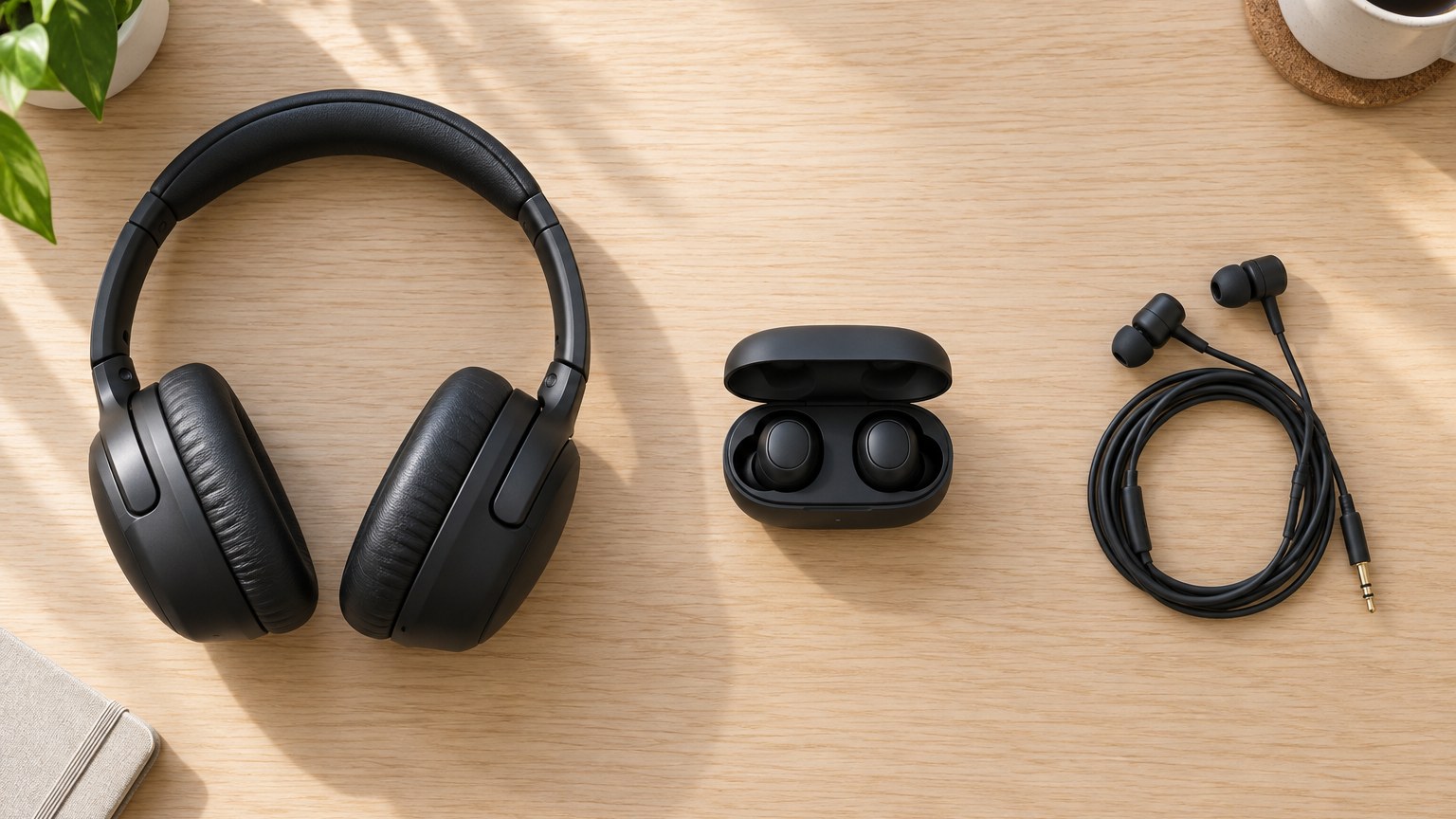
Most "which should I buy" advice starts with sound quality. Wrong starting point. At similar prices the sound gap between these three is smaller than the gap between using them on a train and using them at a desk.
Start with where they will actually live.
Over-ear: the desk-and-commute pick
Big cups seal around your ear, which does two useful things: passive isolation before any processing kicks in, and room for a 40 mm-plus driver. Battery life is the easy win — 30 to 60 hours is normal, because there is space for a real cell.
The catch is that you cannot pocket them, and ears get warm after two hours. In summer, over a long day, that matters more than any spec sheet. Our R5 and R7 sit in this category.
True wireless: the pick you will actually carry
The honest advantage of TWS is not sound, it is that the case lives in a pocket and you stop thinking about it. Expect 4-8 hours in the buds and 20-30 hours including the case.
Where they lose: sustained bass authority, and long-session comfort if the nozzle angle does not suit your ear canal. Fit is very personal here, and no review can predict it for you. The TWS-X6 is a reasonable place to start if you are new to the format.
Wired: cheapest route to good sound
No battery, no pairing, no latency, and every cent of the price went into the driver instead of a radio and a cell. At the $12-$25 mark, wired beats wireless on sound quality essentially every time — it is not close.
You pay in cable. It tangles, it snags, and if your phone dropped the 3.5 mm jack you need the right connector version — a DS-800 Type-C rather than an analogue plug.
The quick version
- Long flights, focus work, one long session a day: over-ear.
- Short trips, gym, taking calls, in and out all day: true wireless.
- Best sound per dollar, or a backup pair that never needs charging: wired.
Who should ignore this article
If you already own a pair you like, do not upgrade sideways. Moving from a decent $40 over-ear to a decent $40 TWS is not an upgrade, it is a change of inconvenience. Buy a second form factor for a second situation instead — that is the purchase people are actually happy with a year later.